
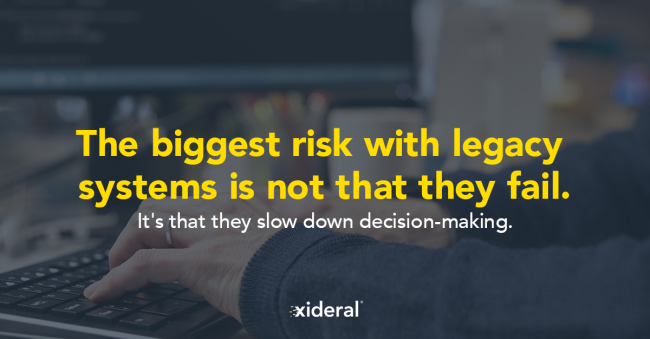
Legacy systems and business decisions. The hidden risk many companies overlook
Seventy four percent of companies say their legacy systems limit their ability to innovate.
Yet many of those platforms continue to operate every day.
They process payments.
They manage inventory.
They support critical operations.
Because of this, many organizations do not see an immediate problem.
The real risk appears when the business needs to make decisions quickly and technology cannot respond at the same pace.
At that moment legacy systems stop being just old infrastructure. They become a silent barrier that slows operations, limits innovation, and makes it harder for companies to adapt to new markets.
How legacy systems slow down business speed
Many organizations believe legacy systems represent only a technical issue. In reality, their biggest impact appears in the way companies make decisions.
When technology architecture is rigid, accessing relevant information can take too long. Data is stored across different platforms, integrations are limited, and reports depend on manual processes.
This creates friction across the organization.
Leaders must wait longer to access reliable insights. Technology teams spend most of their time maintaining existing systems. New digital initiatives take longer to implement.
The system still works, but the organization moves more slowly.
Decisions with legacy systems
Disconnected data
Manual integration
Delayed reports
Slower decisions
Why modernizing legacy systems becomes a strategic priority
Companies operating in digital markets need more than stable infrastructure. They need speed.
Organizations must integrate new platforms, analyze data from multiple sources, and launch digital services faster than ever before.
Legacy systems make these processes more complex because they were designed for technological environments very different from today’s.
This does not mean companies must immediately eliminate every existing platform. Many legacy systems remain essential for daily operations.
The real priority is finding ways to evolve the technology architecture while keeping the business running.
However, these outcomes require more than algorithms. They demand clean data, integrated systems, and cross-functional alignment.
In other words, AI must support business decisions — not just technical experimentation.
Traditional architecture
Slow changes
Complex integrations
vs
Modern architecture
Connected systems
Faster innovation
Modernizing legacy systems without replacing everything
One of the most common misconceptions in digital transformation projects is believing the only solution is replacing all existing systems.
In many cases, the most effective approach is gradual modernization.
Organizations can create integration layers, develop APIs that connect older applications with modern platforms, and build software that enables key processes to scale.
The goal is not to remove legacy systems overnight.
The goal is to reduce the technological friction that slows business operations.
When companies achieve this balance, technology returns to its original purpose. It supports faster decisions, enables innovation, and helps organizations adapt to new opportunities.
When technology accelerates decisions
Organizations that modernize their technology architecture integrate new tools faster, access relevant data sooner, and develop digital solutions that support business evolution.
Instead of reacting slowly to market changes, these companies adapt with greater agility.
That is why the conversation about legacy systems is no longer limited to the technology department. It has become a strategic discussion that directly impacts business competitiveness.
At Xideral, we collaborate with organizations that want to accelerate technology modernization through specialized talent and development teams that integrate quickly into initiatives such as system evolution, platform integration, and software development.
When technology architecture evolves, the business moves forward as well.
If your organization is exploring ways to modernize legacy systems without disrupting operations, models such as Staff Augmentation or Software Factory can help accelerate that transition with specialized teams.
Xideral Team