

The C++ language is one of the foundations of modern programming. Its combination of performance, flexibility, and tools for organizing code has made it widely used in video games, operating systems, high-performance applications, and engineering projects.
Its story began in the late 1970s, when an engineer sought a way to develop more complex software while taking advantage of the capabilities of a programming language he already knew.
Who Created the C++ Language?
The C++ language was created by Bjarne Stroustrup, a Danish computer scientist who worked at Bell Labs in the United States.
In 1979, Stroustrup began developing a project initially called C with Classes. His experience with C and his interest in object-oriented programming led him to explore a new way of writing software that combined efficiency with a more structured approach to development.
His work laid the foundation for a programming language that would eventually expand into different industries and technological applications.

Why Was the C++ Language Created?
The development of the C++ language responded to a growing need: building increasingly complex software while maintaining the performance and control offered by C.
Stroustrup wanted to combine features from two programming languages:
C: Efficiency and Control
C offered execution speed, access to system resources, and memory control. These capabilities made it particularly useful for developing software where performance was a priority.
Simula: Object-Oriented Programming
Simula introduced concepts such as classes and object-oriented programming, which made it possible to organize code into reusable structures and represent entities through attributes and behaviors.
Stroustrup drew inspiration from these concepts to develop C with Classes, integrating code organization tools with the efficiency of C.
From C with Classes to C++: Its Evolution
The C++ language evolved through several stages that expanded its capabilities and contributed to its adoption across the technology industry.
- 1979: C with Classes Begins
- Bjarne Stroustrup begins developing C with Classes at Bell Labs. The project introduces object-oriented programming concepts built upon the foundations of C.
- 1983: The Name C++ Is Introduced
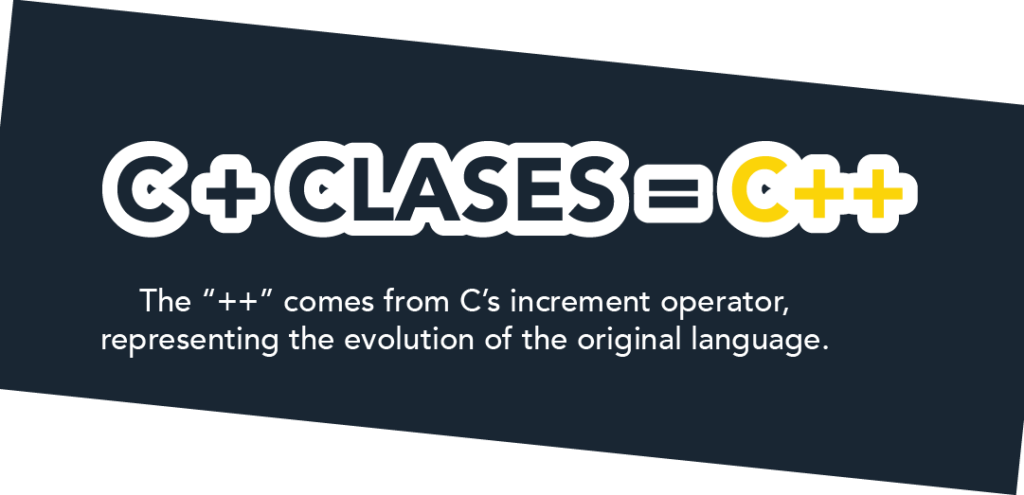
- The language adopts the name C++. The
++symbol represents the increment operator in C, reflecting the evolution of the original language. - 1985: The First Commercial Release
- Stroustrup publishes the first edition of The C++ Programming Language, while C++ begins commercial distribution and gains recognition among developers.
- 1998: The First ISO Standard
- C++ receives its first international standard, known as C++98. This milestone establishes a common foundation for its implementation and development across different platforms.
What Does the Name C++ Mean?
The name C++ comes from the increment operator ++, used in the C language to increase the value of a variable.
The name represents the evolution of C and the addition of new programming tools and capabilities.
This detail also reflects the relationship between both languages: C++ retains many elements of C while expanding its capabilities to support different types of software development.

What Is the C++ Language Used for Today?
The C++ language continues to play a role in technological projects that require performance, precision, and resource control.
Some of its most common applications include:
- Video games and graphics engines: It helps develop rendering systems, physics engines, and performance-intensive components.
- Operating systems: It is used to develop components and tools that interact with system resources.
- High-performance software: It supports applications that require efficient processing and fast response times.
- Electronics and smart devices: It enables programming systems that interact with sensors, components, and hardware.
- Engineering and simulations: It facilitates complex calculations, physical simulations, and computational models.
C++: An Evolution That Continues to Shape Technology
Since its origins at Bell Labs, the C++ language has evolved alongside the needs of the technology industry. Its combination of performance, control, and programming tools makes it possible to develop solutions ranging from low-level systems to complex software applications.
Understanding how C++ was created also provides insight into some of the decisions that shaped modern programming and why certain languages remain relevant across technological projects of different scales.
Its history demonstrates how an idea designed to address engineering challenges can become a fundamental software development tool for decades.
Xideral Team