
Pi Day: When Mathematics Becomes a Celebration
March 14 may seem like an ordinary day. But when you write the date in numeric format (3/14), something clicks: 3.14.
And that is where the story of Pi Day begins.
What looks like an endless decimal to some is, for millions around the world, a date that symbolizes science, precision, and intellectual curiosity.
What Is Pi Day and Why Is It Celebrated on March 14?
Pi Day is celebrated every March 14 because the date matches the first three digits of the mathematical constant π (3.14). This number represents the ratio between a circle’s circumference and its diameter and is fundamental in geometry, physics, engineering, and technology.
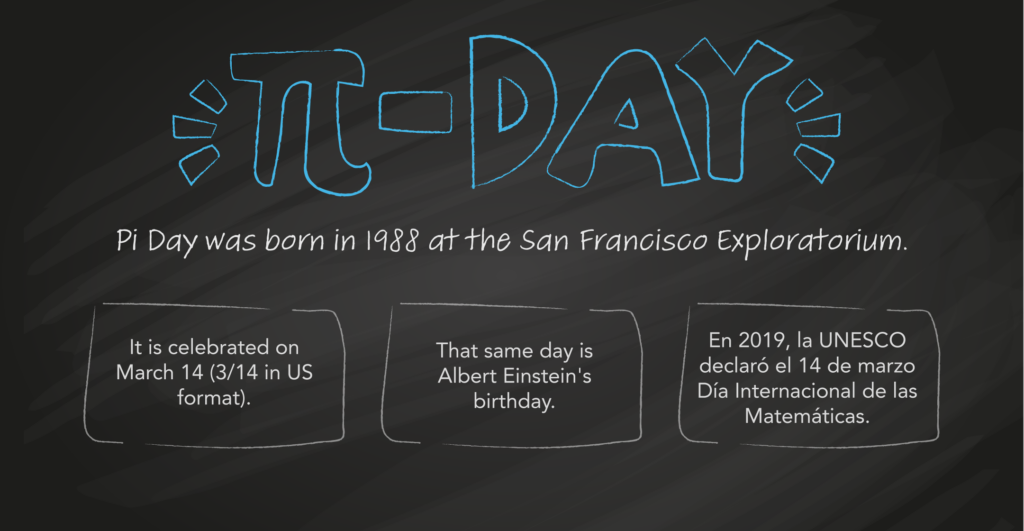
The modern celebration began in 1988 at the San Francisco Exploratorium, thanks to physicist Larry Shaw, who organized an event to honor this mathematical constant.
Over time, Pi Day moved beyond a local initiative and became an internationally recognized celebration within educational and scientific communities.
Interestingly, March 14 is also the birthday of Albert Einstein, adding even more scientific symbolism to the date.
The Historical Evolution of π
The number π is not a modern discovery. Its history dates back more than 4,000 years.
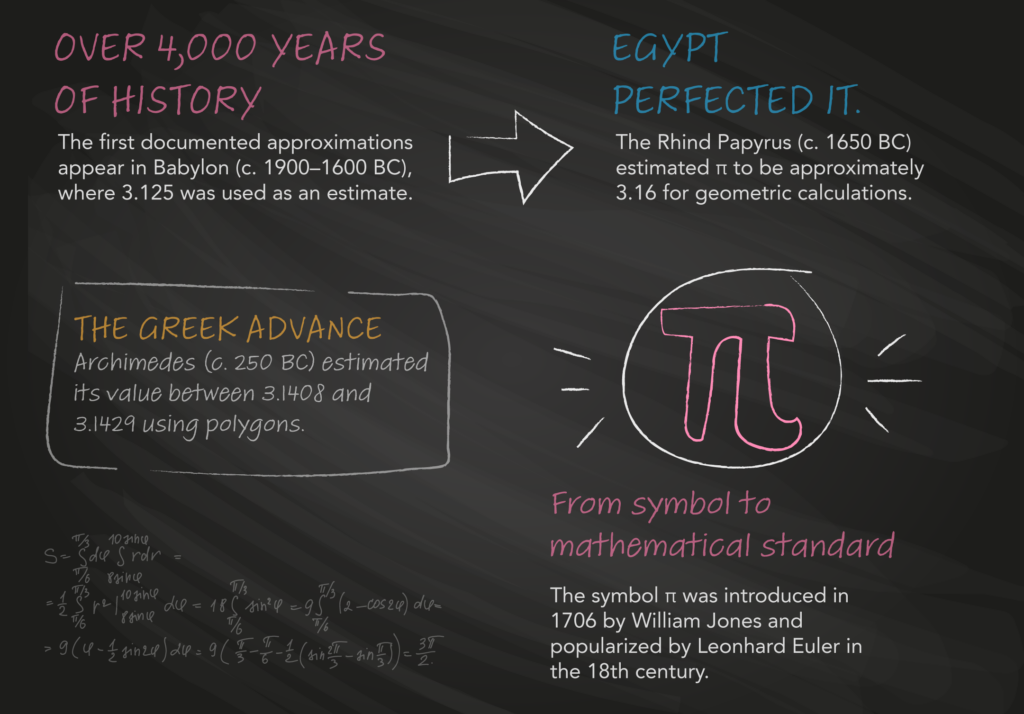
Ancient Babylonian civilizations used approximations close to 3.125 to solve geometric problems. In Egypt, mathematical documents such as the Rhind Papyrus show advanced approximations for their time.
Later, the Greek mathematician Archimedes significantly improved the precision of π by using inscribed and circumscribed polygons, a groundbreaking achievement in mathematical history.
In 1706, Welsh mathematician William Jones introduced the symbol π, which was later popularized in the 18th century by Swiss mathematician Leonhard Euler.
What makes π remarkable is that it is an irrational number — its decimals continue infinitely without repeating. Today, trillions of digits have been calculated using advanced computing systems, although only a handful are necessary for practical scientific applications.
Pi Day honors this long journey of discovery and precision.
Pi Day as a Cultural and Educational Symbol
Pi Day is more than a mathematical observance. It has become a cultural symbol that promotes logical thinking and scientific education.
In 2019, UNESCO officially proclaimed March 14 as the International Day of Mathematics, aligning it with Pi Day and reinforcing its global importance.
Today, Pi Day represents humanity’s ability to measure, understand, and model the world around us.
- Schools host memorization contests.
- Universities organize lectures.
- Communities celebrate science through educational events.
What began as a niche celebration is now a worldwide recognition of mathematical achievement.
Why Pi Day Matters Today
We live in an era driven by technology, programming, artificial intelligence, and engineering. At the core of all these fields lies mathematics.
Pi Day serves as a reminder that behind every app, every algorithm, and every structural design, there is a mathematical foundation.
Every bridge.
Every circular structure.
Every data model.
At some point, π is involved.
Celebrating Pi Day is not just about honoring a number. It is about recognizing the centuries of knowledge that continue to power innovation today.
Before every breakthrough, there was a formula.
Behind every formula, there was curiosity.
And sometimes, that curiosity begins on March 14.
👉 Want to discover more fascinating stories about technology? Don’t miss our upcoming posts.
Xideral Team