
Manufacturing and logistics companies continue investing in AI and automation to reduce operational delays, optimize costs, and improve productivity. However, intelligent logistics automation delivers limited results when organizations implement technology on top of fragmented, manual, or outdated processes.
Although companies adopt advanced platforms, intelligent assistants, and automated workflows, operational bottlenecks still slow down results. Therefore, businesses that achieve real transformation redesign processes before deploying automation.
How intelligent logistics automation transforms operations
Intelligent logistics automation connects systems, data, and operations in real time. In addition, it reduces manual errors and accelerates decision-making across inventory management, transportation, and production workflows.
However, many companies still automate isolated tasks without evaluating the complete operational flow. As a result, they simply digitize existing inefficiencies.
Today, the most common operational challenges in manufacturing and logistics include:
- Duplicated workflows across departments
- Fragmented information between systems
- Slow approval cycles
- Limited operational traceability
- Disconnected automations
- Dependence on manual tasks
Because of this, implementing AI on top of inefficient workflows increases operational costs and reduces ROI.
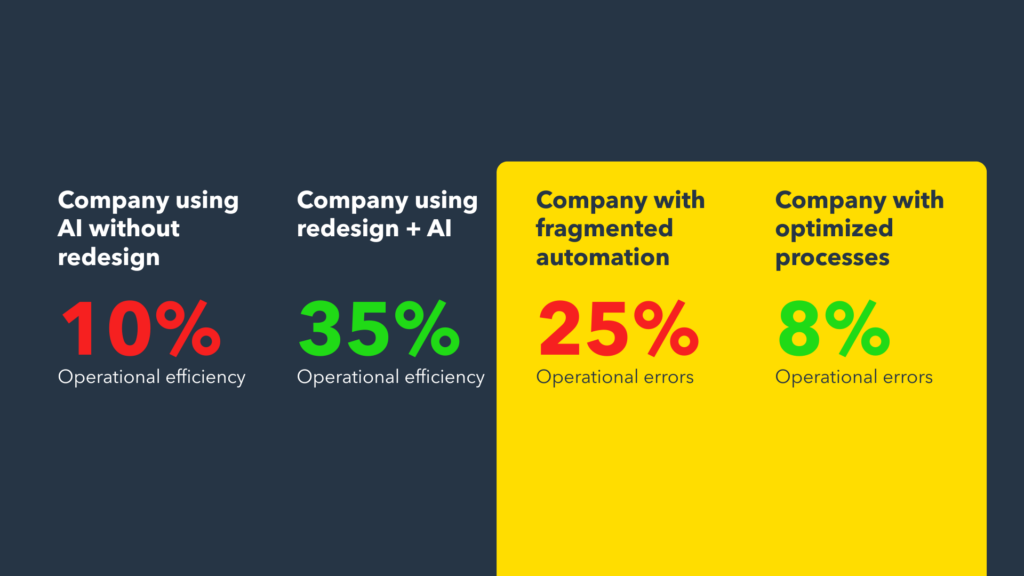
Furthermore, global digital transformation trends show that companies aligning processes with automation can improve operational efficiency by up to 30% while significantly reducing manual errors.
Why intelligent logistics automation requires optimized workflows
AI identifies patterns, automates decisions, and accelerates operations. However, technology completely depends on the quality of the workflow it executes.
For example, if a company still relies on manual approvals or disconnected systems, AI simply replicates those delays at a faster pace.
Leading organizations already changed this approach. Instead of automating immediately, they first analyze critical workflows to identify:
Operational bottlenecks
Repetitive low-value tasks
Unnecessary workflows
Missing integrations
Traceability risks
Afterward, they implement custom software and automation solutions aligned with business objectives.
This strategy creates:
- Greater operational visibility
- Faster system integrations
- Reduced delivery times
- Better internal experience
- Sustainable technology scalability
Additionally, companies combining AI with technical training accelerate adoption and maximize operational impact.
The role of custom software in enterprise automation
Manufacturing and logistics companies require adaptable operations. Therefore, many organizations are moving away from generic platforms and adopting custom software solutions designed around their operational workflows.
Custom software enables:
- Integration between legacy systems and modern platforms
- Personalized automation
- Regional scalability
- Real-time analytics
- Greater operational control
At the same time, Training Academies help teams develop the technical skills required to operate new technologies and accelerate digital transformation initiatives.
Today, the most competitive companies combine three essential elements:
- Process optimization
- Intelligent automation
- Continuous training
As a result, they create more agile and sustainable operations.
AI creates value when companies transform workflows before automating them. In manufacturing and logistics, operational speed depends as much on process structure as it does on technology itself.
Discover how to implement custom software and automation solutions aligned with real business goals at Xideral
Xideral Team