
In the enterprise landscape across LATAM and North America, enterprise vendor lock-in has become a silent constraint that many companies overlook. As organizations accelerate cloud adoption, they also increase reliance on a single provider. As a result, they lose flexibility, face rising costs, and limit their ability to adapt quickly.
Furthermore, this dependency does not only affect operations. It directly impacts long-term strategic decisions and scalability.
The impact of vendor lock-in on enterprise companies
Many organizations adopt technology quickly but fail to evaluate dependency risks. Consequently, they become locked into rigid ecosystems.
Key impacts include:
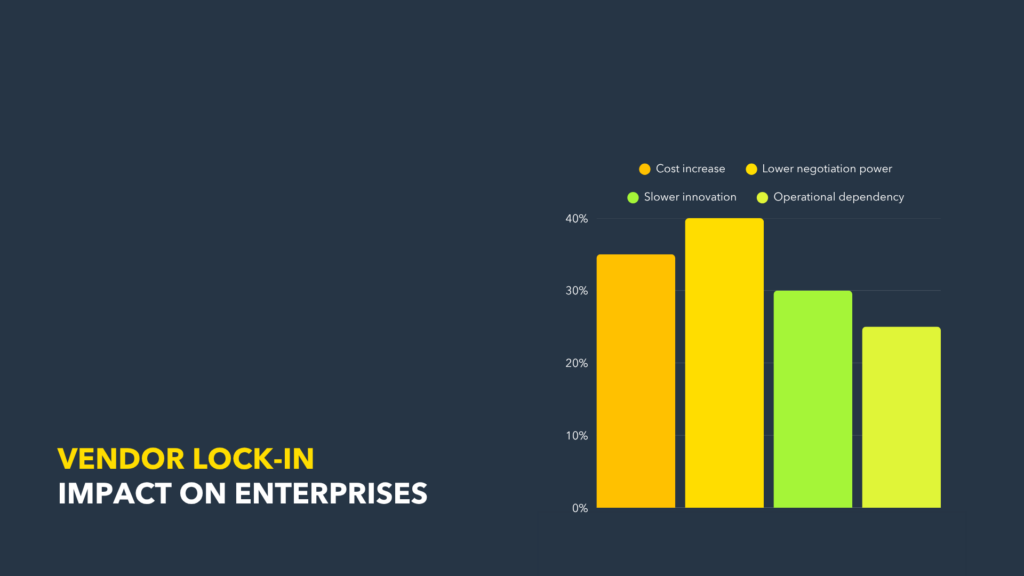
- Up to 35% increase in operational costs during renewals
- Reduced negotiation leverage
- Limited integration with new technologies
- Dependence on provider timelines
Why vendor lock-in restricts innovation
When a company depends on a single provider, innovation slows down. Any change becomes complex and expensive.
Additionally:
Decisions align with the provider’s roadmap
Migration becomes difficult
Emerging technologies become harder to adopt
Therefore, companies stop leading their own technology strategy and start adapting to external limitations.
A vendor-neutral strategy as a strategic solution
To reduce enterprise vendor lock-in, organizations need to move away from provider-centric decisions and adopt a vendor-neutral technology strategy. Instead of relying on a single ecosystem, they design flexible architectures that support interoperability and long-term scalability.
This approach allows companies to maintain control over their technology while still leveraging cloud capabilities. As a result, they avoid restrictions and gain the ability to evolve without friction.
Key capabilities include:
- Multi-cloud environments to prevent single-provider dependency
- Open architectures that enable seamless integrations
- Modular systems that adapt to business growth
Why dependency is a long-term strategic risk
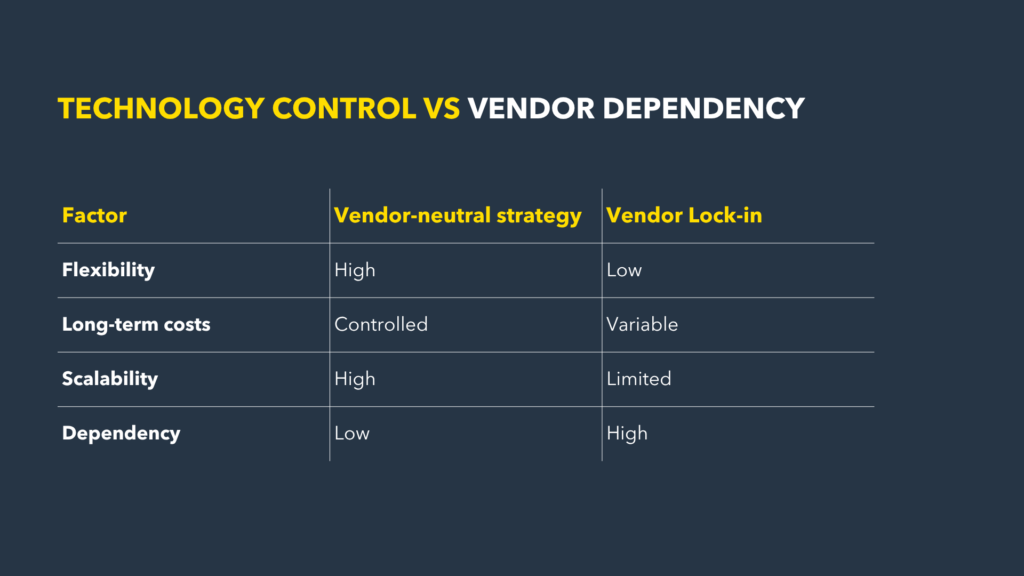
Enterprise vendor lock-in goes beyond a technical limitation. It directly impacts how companies compete, scale, and respond to change. Therefore, organizations that ignore this risk often lose agility over time.
For example, companies with high dependency typically experience:
- Slower implementation of new capabilities
- Greater exposure to pricing changes
- Limited ability to integrate emerging technologies
On the other hand, businesses that adopt a vendor-neutral approach gain resilience and control. They make decisions based on strategy, not restrictions imposed by providers.
Ultimately, reducing dependency transforms technology from a constraint into a growth enabler.
At Xideral, we help organizations design vendor-neutral and scalable technology strategies that reduce dependency and unlock long-term growth.
Explore how to optimize your technology approach 👉Digital Transformation
Xideral Team