
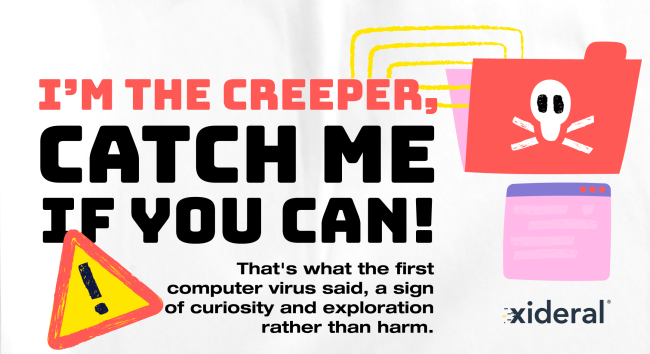
In the history of computing, few milestones are as significant as Creeper, the first self-replicating worm that appeared in 1971 on ARPANET. Developed by Bob Thomas at BBN Technologies, Creeper was not created with malicious intent. Instead, it was designed as an experiment to explore whether a program could move autonomously between interconnected systems.
This context is essential to understanding why Creeper first worm represents a turning point in digital history. At a time when cybersecurity did not yet exist, Creeper revealed both the power and the risks of networked computing.
What Was Creeper and How Did It Work?
Creeper first worm was designed to copy itself from one computer to another across ARPANET, the direct precursor of today’s Internet. Once it reached a new machine, the program executed itself, replicated, and continued moving through the network.
Each time Creeper successfully migrated, it displayed a short message on the screen:
“I’m the Creeper, catch me if you can!”
That was the message shown by the world’s first self-replicating worm. It did not damage files or disrupt systems. Instead, it served as proof that autonomous software could travel freely across a network.

The First Antivirus: Reaper
As Creeper continued to spread, researchers quickly realized they needed a way to remove it. This led to the creation of Reaper, widely recognized as the first antivirus program in history. Reaper’s purpose was to search ARPANET for Creeper instances and delete them.
As a result, Creeper first worm not only introduced the concept of self-replicating malware, but also triggered the birth of cybersecurity. For the first time, engineers acknowledged that connected systems required active defense mechanisms.
Creeper’s Impact on Modern Cybersecurity
Although harmless by today’s standards, Creeper first worm introduced foundational concepts that remain relevant in modern cybersecurity:
- Automatic software propagation across networks.
- The need for detection and removal tools.
- Early awareness of vulnerabilities in interconnected systems.
Studying Creeper helps explain how computer viruses emerged and why cybersecurity became a critical discipline as networks expanded.
The Legacy of Creeper
Creeper was not an isolated experiment. It marked the beginning of a technological lineage that led to increasingly complex worms, viruses, and malware. While modern threats are far more sophisticated, their conceptual roots trace back to that simple program created in 1971.
For this reason, Creeper first worm is more than a historical curiosity. It symbolizes the creativity of early network researchers and serves as an early warning about the challenges of a connected digital world. Its legacy lives on in every modern cybersecurity system.
👉 Want to discover more fascinating stories about technology? Don’t miss our upcoming posts.
Xideral Team