
A few decades ago, storing a document meant saving it on a physical device. Today, data storage evolution allows users and organizations to access enormous amounts of information from almost anywhere. The journey from floppy disks to cloud platforms reflects one of the most important transformations in modern computing.
Storage technology has consistently followed one objective: storing more information in less space while making access faster and more convenient. Each generation introduced a different balance between capacity, portability, cost, and accessibility.
From floppy disks to portable storage
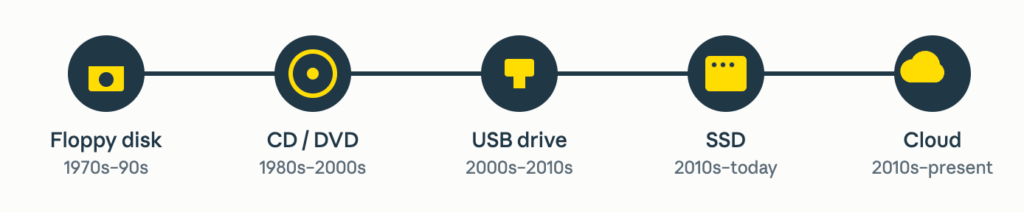
The floppy disk became one of the most recognizable storage formats of the personal-computing era. Early versions offered extremely limited capacity compared with today’s standards. However, they provided something revolutionary at the time: a practical way to move digital files between computers.
As files became larger, users needed more capacity. CDs and DVDs expanded storage options and made it easier to distribute software, music, videos, and documents.
Then came USB flash drives. Their compact design made them especially useful for everyday file transfers. A small device could carry documents, presentations, photographs, and other digital assets without requiring a bulky storage system.
This stage of data storage evolution also changed expectations. Storage became increasingly portable, reusable, and convenient.
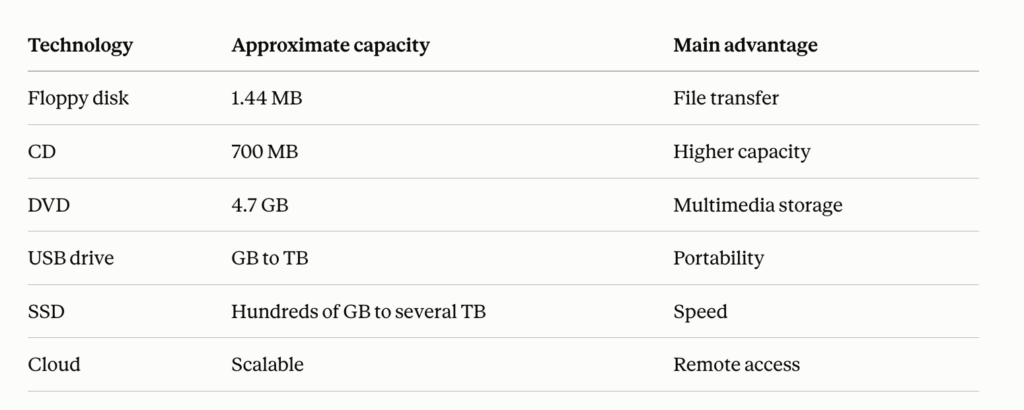
A simple comparison
rom USB to SSD: speed becomes essential
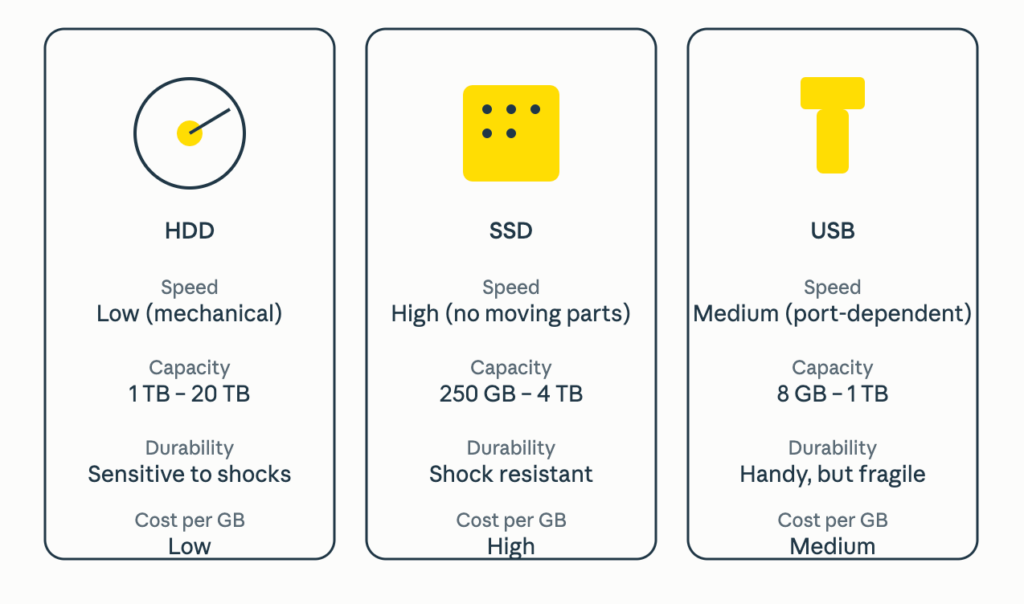
Storage evolution did not focus only on capacity. Speed became equally important.
Traditional hard disk drives used mechanical components to read and write information. Solid-state drives changed that model by using flash memory. As a result, computers could access data much faster, improving boot times, application performance, and file transfers.
Meanwhile, USB technology continued evolving. Newer standards increased transfer speeds and enabled users to move increasingly large files in less time.
However, physical storage still required users to manage devices, maintain backups, and keep track of where information lived.
That challenge opened the door to another major transformation.
The cloud changes the storage model
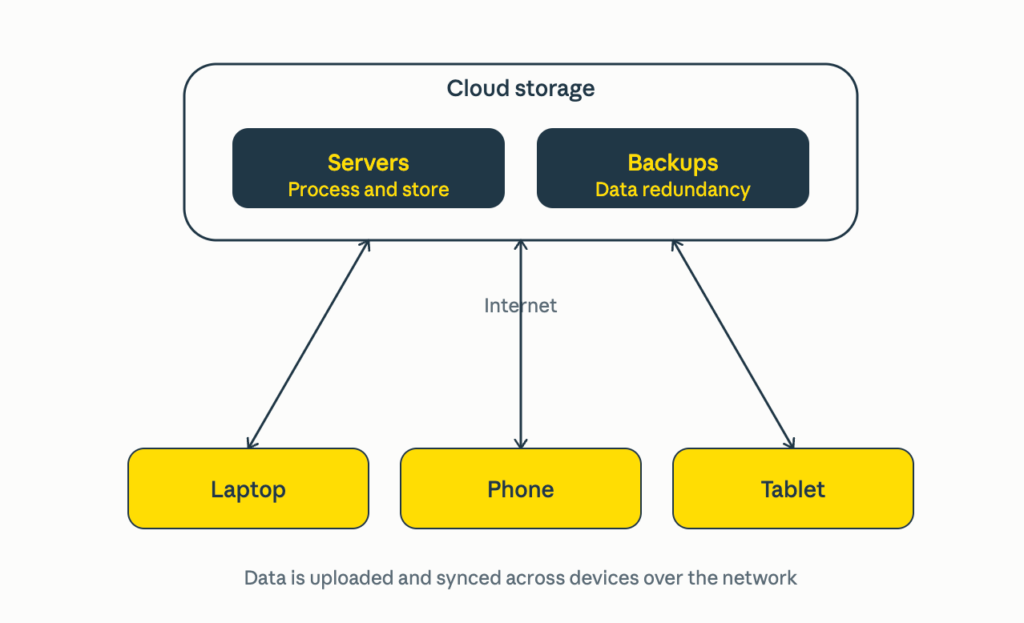
Cloud storage introduced a different way to think about digital information. Instead of keeping every file on a personal device, users could store data on remote infrastructure and access it through an internet connection.
This shift represents a major stage in data storage evolution because it changes the relationship between information and physical hardware.
The cloud offers several practical advantages:
- Access files from multiple devices.
- Synchronize information across users and locations.
- Scale storage according to demand.
- Support automated backups and recovery.
- Facilitate collaboration on shared documents.
- Reduce dependence on individual physical devices.
For businesses, this model also supports distributed teams, digital services, analytics, and applications that require large amounts of information.
What comes next for data storage?
The next stage of data storage evolution will involve more than simply increasing capacity. Organizations will need storage architectures that combine performance, accessibility, security, resilience, and efficient data management.
Technologies such as edge computing, distributed storage, AI workloads, and increasingly sophisticated cloud architectures will continue influencing how companies manage information.
The transformation can be summarized in five stages:
- Floppy disks: portable digital files.
- Optical media: greater capacity and distribution.
- USB drives: convenient personal storage.
- SSDs: faster local access.
- Cloud platforms: scalable and connected storage.
The remarkable part is the change in scale. A device once used to transport a few megabytes has evolved into an ecosystem capable of managing enormous datasets across globally distributed infrastructure.
For companies, the real opportunity lies in choosing the right storage architecture for each business need. Data storage evolution shows that technology changes quickly, but the objective remains consistent: make information easier to store, access, protect, and use.
Ready to explore how modern technology can improve the way your organization manages information? Discover Xideral’s data services and explore solutions designed around your business needs.
Or check out more post like this.
Xideral Team