
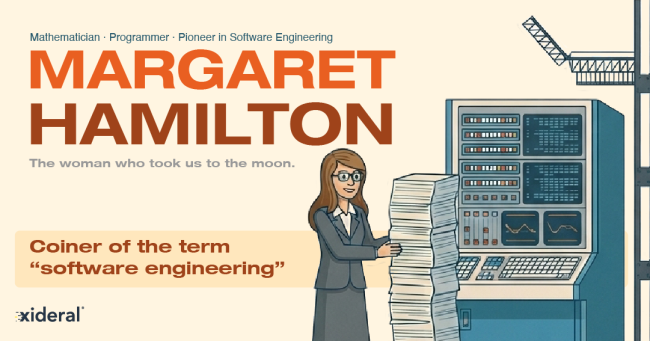
When people think about the first Moon landing, they often picture astronauts, rockets, and the lunar module. But behind that historic mission, Margaret Hamilton and her team developed software that helped NASA guide the Apollo spacecraft. Working at MIT’s Instrumentation Laboratory, Hamilton led the team responsible for the onboard flight software used in Apollo’s command and lunar modules. Her work helped establish new ideas about how software should handle errors, prioritize important tasks, and work alongside people.

Building software for an extraordinary mission
During the 1960s, computers were very different from the devices we use today. The Apollo Guidance Computer had limited computing power, so programmers had to make every instruction count. Hamilton’s team created software that could manage several tasks while the spacecraft followed its mission.
The team also designed the software to respond when something unexpected happened. Instead of assuming that everything would always work perfectly, they considered possible errors and created ways for the system to recover. NASA later recognized concepts from Hamilton’s work, including priority scheduling, asynchronous software, end-to-end testing, and systems that allowed astronauts to remain part of the decision-making process.

The Apollo 11 alarm
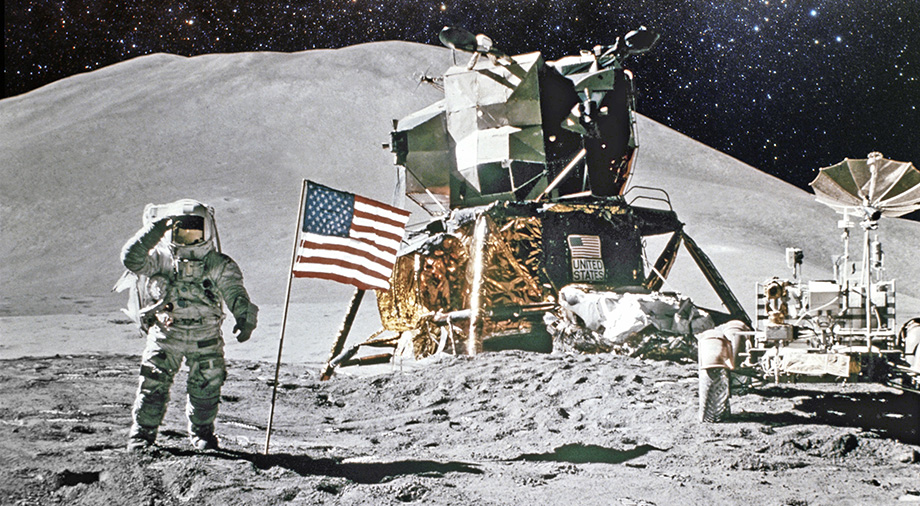
On July 20, 1969, the Apollo 11 lunar module Eagle began its final descent toward the Moon. During the landing, the computer displayed the 1201 and 1202 program alarms.
The alarms indicated that the computer had more work than it could process at that moment. However, the software had been designed to deal with this situation. It discarded lower-priority tasks and continued processing the tasks that mattered most for the landing. NASA flight controllers received information about the alarms and allowed the descent to continue.
This event demonstrated why careful software design mattered. The computer did not simply stop when it became overloaded. Its software recognized the problem and used its recovery routines to keep important operations running. Hamilton’s team had deliberately built this kind of behavior into the system.
Where “software engineering” came from
Margaret Hamilton also helped give software development a new identity. During her work on Apollo, she used the term “software engineering” to emphasize that software deserved the same level of discipline and respect as other engineering fields.
NASA describes the concepts developed by Hamilton and her team as building blocks of modern software engineering. The Computer History Museum also credits her with fundamental contributions to the field and notes that she used the term to give software work greater legitimacy as an engineering discipline.
Her approach focused on more than writing code that worked under normal conditions. She wanted teams to think about what could go wrong, test their systems carefully, and design software that could respond to unexpected situations.
A legacy that reaches beyond the Moon
The ideas developed during Apollo influenced Hamilton’s later work in software reliability. After her NASA work, she continued developing methods for creating reliable software and systems through her own companies and research.
In 2003, NASA gave Hamilton the NASA Exceptional Space Act Award for her scientific and technical contributions to the Apollo program. In 2016, President Barack Obama awarded her the Presidential Medal of Freedom, one of the highest civilian honors in the United States.
Margaret Hamilton showed that successful space missions depend on more than powerful rockets. They also depend on carefully designed software that can handle pressure, unexpected problems, and critical decisions.
Her story connects the history of space exploration with the history of computing—and shows how a few lines of code can play a role in one of humanity’s biggest achievements.
Xideral Team