

Emoji history began in Japan during the 1990s, when mobile phones had tiny screens and messaging services imposed strict character limitations. Designers needed a compact way to communicate information, emotion and context without using additional words.
Today, a single emoji can add emotion to an entire sentence. However, the original concept looked very different from the colorful keyboard we use today. Early designers worked with extremely limited screen space and had to make every pixel count.
That constraint created an important design challenge: how could one tiny symbol communicate an idea instantly?
Emoji history has a Japanese origin
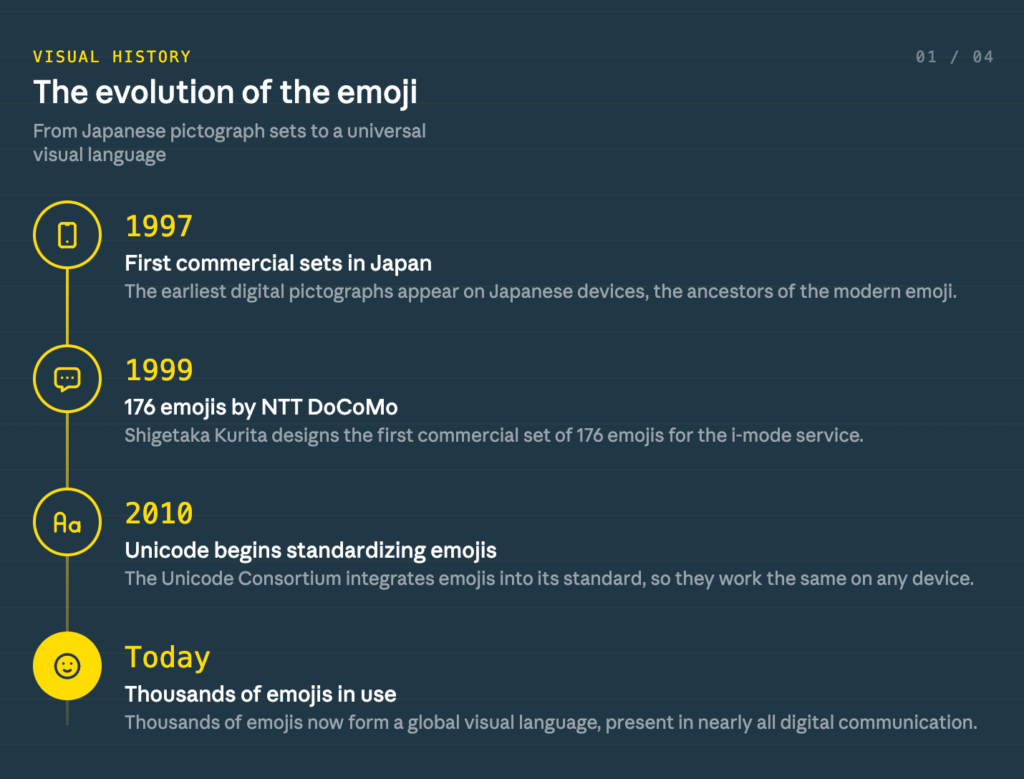
For years, many articles credited Japanese interface designer Shigetaka Kurita as the creator of the first emoji. The full story, however, has another chapter.
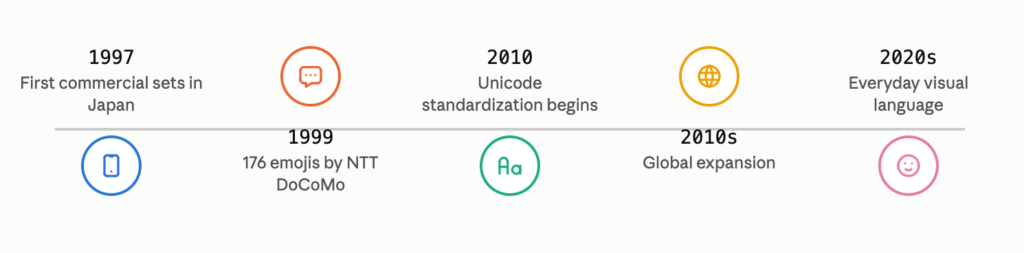
In 1997, Japanese carrier J-Phone, later associated with SoftBank, released a mobile phone containing a set of around 90 emoji. That release predates NTT DOCOMO’s influential 176-character set from 1999.
Therefore, it is more accurate to describe Kurita’s work as one of the most influential early emoji sets rather than simply calling it the first.
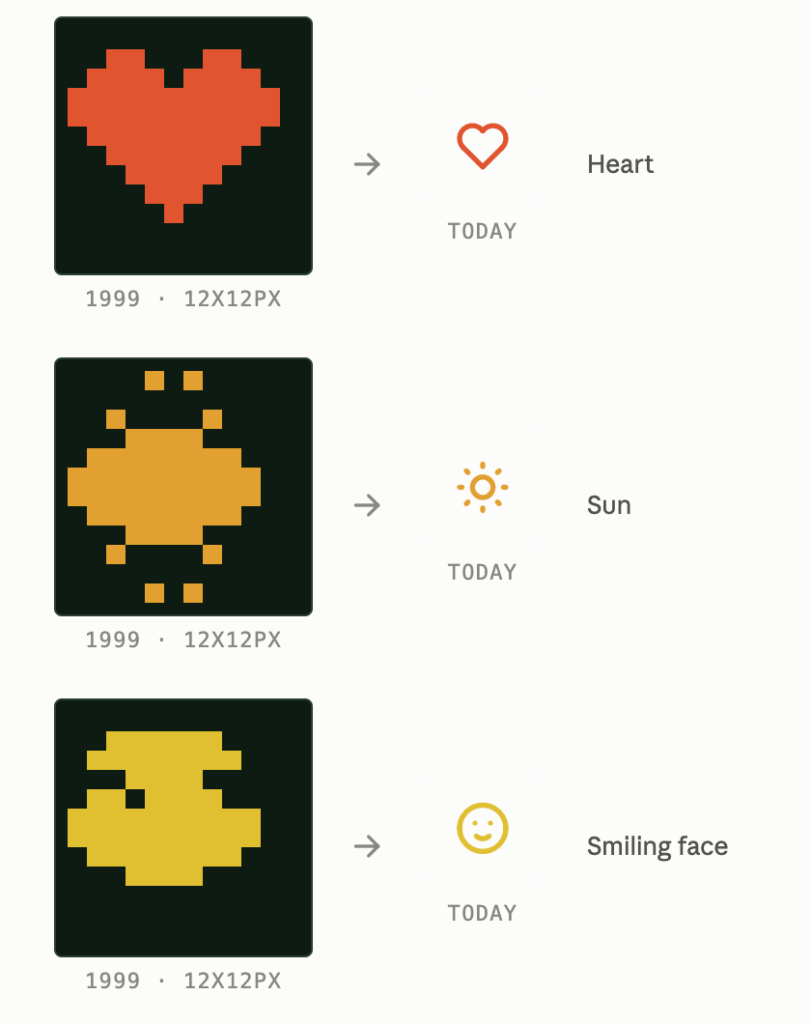
In 1999, Kurita and his colleagues at NTT DOCOMO developed 176 pictograms for the company’s i-mode mobile internet service. They designed them on a remarkably small 12 × 12 pixel grid.
The goal was practical: communicate more meaning in less digital space.
What did the first emojis look like?
The original collection looked much more like an information system than today’s emoji keyboard. Many symbols represented practical concepts rather than emotions.
The 176-character set included:
- ☀️ Weather symbols.
- 🚗 Transportation.
- 📱 Technology.
- ❤️ Hearts and other symbols.
- 🌙 Moon phases.
- 🙂 Facial expressions.
- 🏪 Everyday services.
Kurita drew inspiration from Japanese manga, existing emoticons, pictograms and the Zapf Dingbats typeface.
Interestingly, only five facial expressions appeared in the original set: happy, sad, angry, disappointed and dizzy. The collection focused primarily on helping users navigate and understand mobile information services.
Emoji history changed digital communication
The biggest contribution of emojis went beyond visual design. They solved a communication problem that still exists today: written messages lack facial expressions, gestures and vocal tone.
Consider a simple “okay.” Depending on the context, it can sound friendly, neutral or distant. Adding a symbol can immediately change the emotional reading of the message.
The Museum of Modern Art describes emojis as a way to introduce nuances similar to body language into electronic communication.
As a result, these tiny graphics became more than decoration. They became a new layer of digital language.
From Japanese mobile phones to a global standard
Early emoji systems created a compatibility problem. Different companies could design their own symbols, so the same concept could look different across devices or fail to display altogether.
Unicode helped solve that problem by providing shared character encoding. Standardization allowed emoji to move across operating systems, platforms and markets while maintaining a common underlying character identity.
That shift accelerated their global adoption during the 2010s.
A tiny design that became a global language
Emoji history shows how technological constraints can inspire new forms of communication. Designers started with a 12 × 12 pixel grid, yet those limitations helped create a visual system capable of adding information, emotion and context to digital messages.
Today, emojis appear in conversations, social media, marketing, interfaces and even professional communication. Their designs continue to evolve alongside technology and culture.
The most remarkable part remains their original idea: communicate a complex feeling or concept through one small visual symbol.
Want to discover more stories behind the technology we use every day? Check out or blog Xideral Notes.
If you want to explore more insights like this, you can visit our blog, Xideral Notes, where we share ideas, trends, and perspectives for tech professionals and organizations.
Xideral Team