

Global companies face constant pressure to move faster, access specialized technology skills, and maintain competitive operations. In this environment, nearshoring is evolving from a cost-saving alternative into a strategy for accelerating growth. For Canadian and global companies, working with nearby technology talent can expand capabilities while reducing the limitations of local hiring.
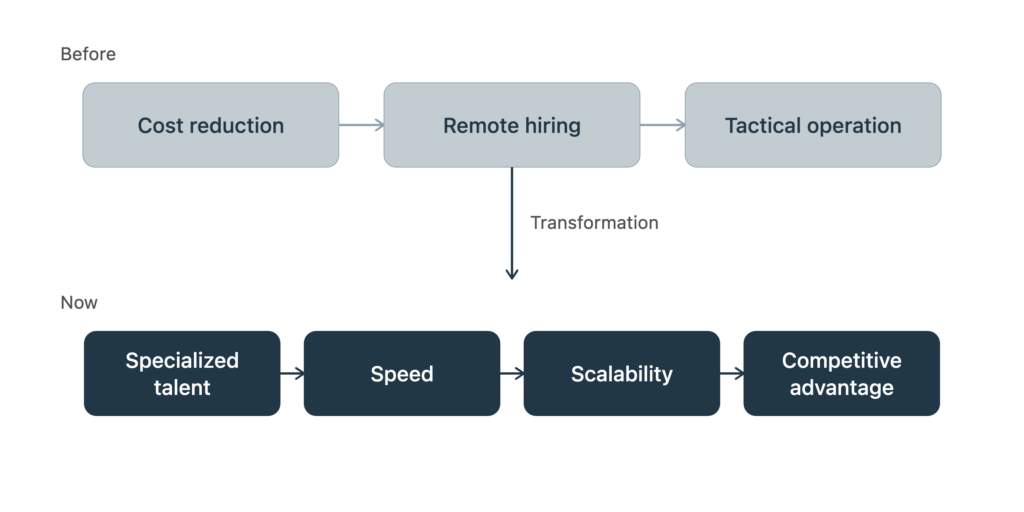
The shift is significant. In the past, companies focused primarily on financial efficiency. Today, the conversation centers on specialized talent, speed, flexibility, scalability, and business continuity.
How Nearshoring Is Changing Its Purpose
For years, companies viewed nearshoring mainly as a way to access professional talent at a more competitive cost. However, that approach no longer captures its full business value.
Technology teams now need to respond quickly to new projects, modernize platforms, implement artificial intelligence, strengthen cybersecurity, and develop digital products. Therefore, hiring based only on price does not create a sustainable advantage.
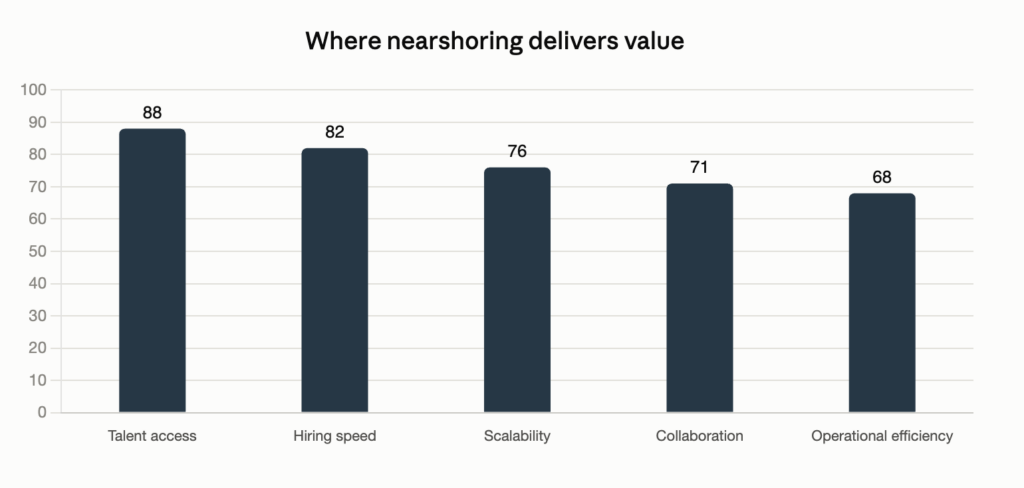
The real value emerges when organizations can add specialists who integrate quickly into existing teams, work within compatible time zones, and contribute from the early stages of a project.
Proximity also improves collaboration. Teams can work during overlapping business hours, resolve blockers in real time, and reduce the waiting cycles that often affect traditional offshore models.
Nearshoring and Specialized Talent
Technology markets continue to evolve rapidly. Companies do not always need more people. They need the right skills at the right time.
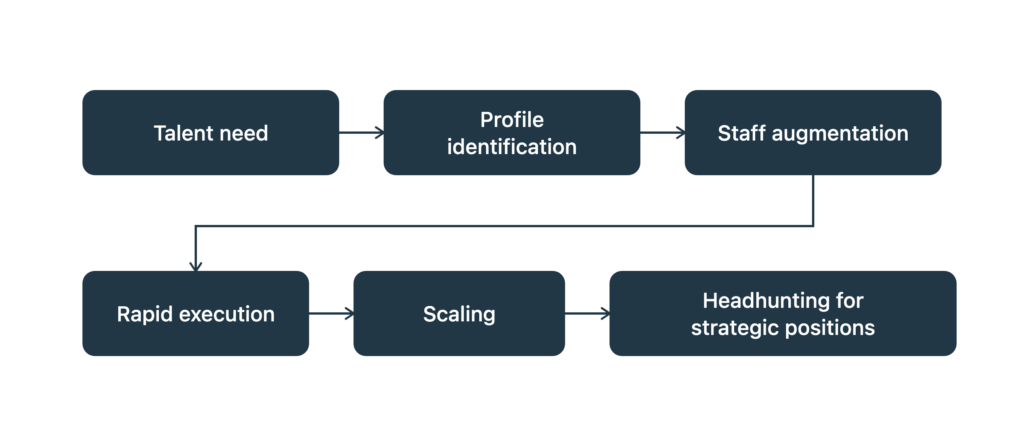
That is why Staff Augmentation models are becoming increasingly relevant. Organizations can complement their teams with specialists in:
- Cloud and DevOps.
- Data Engineering and Analytics.
- Artificial intelligence and machine learning.
- Cybersecurity.
- SAP, Salesforce, and enterprise platforms.
- Full-stack development.
- QA and automation.
- Solution architecture.
This flexibility allows companies to address specific requirements without turning every new need into a permanent hiring process.
Furthermore, access to specialized talent can reduce one of the biggest challenges facing technology leaders: the time required to identify highly qualified
Nearshoring as a Competitive Advantage in 2027
In 2027, companies that use nearshoring strategically will be better positioned to turn technology capacity into a business advantage.
The reason is straightforward: execution speed directly affects competitiveness. When a company can add a specialist, launch a project, and increase team capacity without going through a lengthy hiring process, it can respond faster to market opportunities.
For Canadian companies, the time-zone advantage also makes collaboration with Latin American technology teams particularly effective. Teams can hold meetings, technical sessions, code reviews, and incident-resolution activities during overlapping working hours.
The model also benefits global organizations that need to distribute technology capacity while maintaining strong coordination.
From Project-Based Support to Growth Strategy
The most important change is to stop treating nearshoring as a temporary solution.
A strategic model can help organizations:
Close critical skill gaps.
Accelerate high-priority projects.
Build specialized technology teams.
Build specialized technology teams.
Complement permanent hiring strategies.
Reduce the time between identifying a business need and executing a solution.
This is where Headhunting and Staff Augmentation can work together. Headhunting helps identify professionals for critical, long-term positions, while Staff Augmentation provides flexible capacity when the business cannot afford to wait.
The Future of Nearshoring Is Speed
The value of nearshoring is no longer determined only by how much a company can save. It is determined by how much faster the company can move.
By 2027, the most competitive organizations will combine specialized talent, flexibility, and execution speed to respond to changing market demands. In this context, nearshoring moves beyond traditional outsourcing and becomes a strategic extension of the internal technology team.
For Canadian and global companies, the key question is no longer simply whether they need to reduce costs. Instead, they should ask how quickly they need to access the capabilities required for their next stage of growth.
If your organization needs to expand its technology capacity, access specialized professionals, or accelerate a strategic project, explore our Staff Augmentation and Headhunting solutions and discover how specialized talent can become a competitive advantage.
Xideral Team