

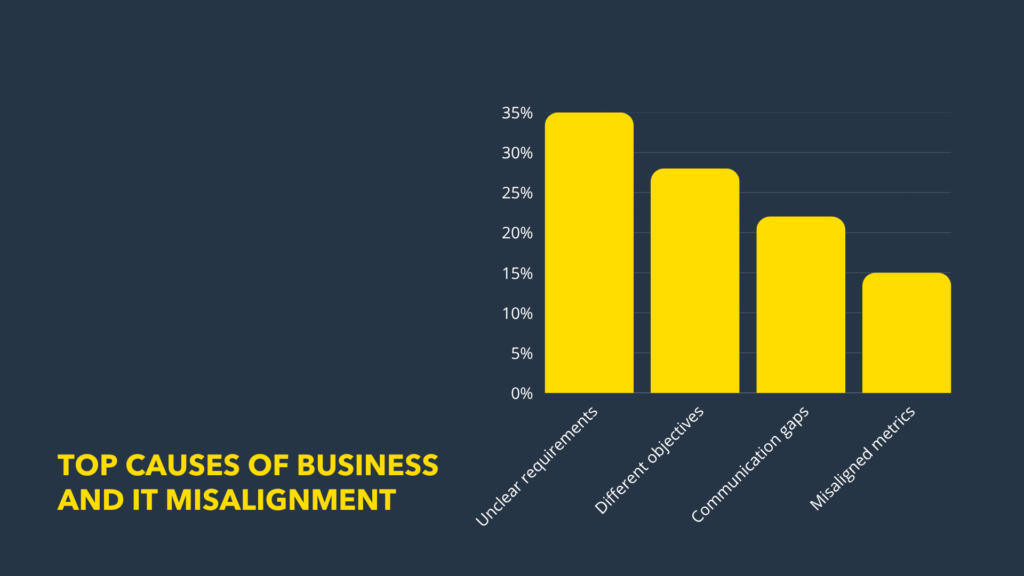
IT-business alignment is one of the strongest predictors of digital transformation success. Yet many organizations continue to struggle because business and technology teams pursue different objectives, measure performance differently, and rarely share the same priorities.
Business leaders focus on growth, efficiency, and customer outcomes. Technology teams focus on architecture, reliability, scalability, and security. Although both perspectives are important, they often create disconnects that limit organizational performance.
The issue is not technology. It is communication.
When communication breaks down, companies invest significant resources in solutions that meet technical requirements but fail to generate meaningful business value.
Why IT-Business Alignment Remains a Major Challenge
Many organizations assume that business and IT naturally understand each other. In reality, both groups often interpret goals through different lenses.
For example:
- Business focuses on revenue growth.
- IT focuses on risk reduction.
- Business prioritizes speed.
- IT prioritizes stability.
- Business measures commercial impact.
- IT measures technical performance.
As a result, projects frequently encounter delays, misunderstandings, and conflicting expectations.
In many cases, technology teams become involved only after requirements have already been defined. Consequently, they receive incomplete information and must interpret business needs without sufficient context.
How IT-Business Alignment Improves Solution Adoption
Organizations often measure success by deployment milestones. However, real value emerges only when people actively use the solution.
Low adoption typically occurs when end users are excluded from the design process or when technical teams build features based on assumptions instead of validated needs.
In these situations, the platform may perform perfectly from a technical standpoint, yet users fail to embrace it.
Common indicators include:
- Low platform utilization.
- Shadow processes outside the system.
- Resistance to change.
- Increased support requests.
- Lower-than-expected ROI.
Therefore, companies must create ongoing communication channels between business stakeholders and technology teams.
Training Academies as a Catalyst for IT-Business Alignment
One of the most effective ways to bridge the gap between business and technology is through strategic learning initiatives.
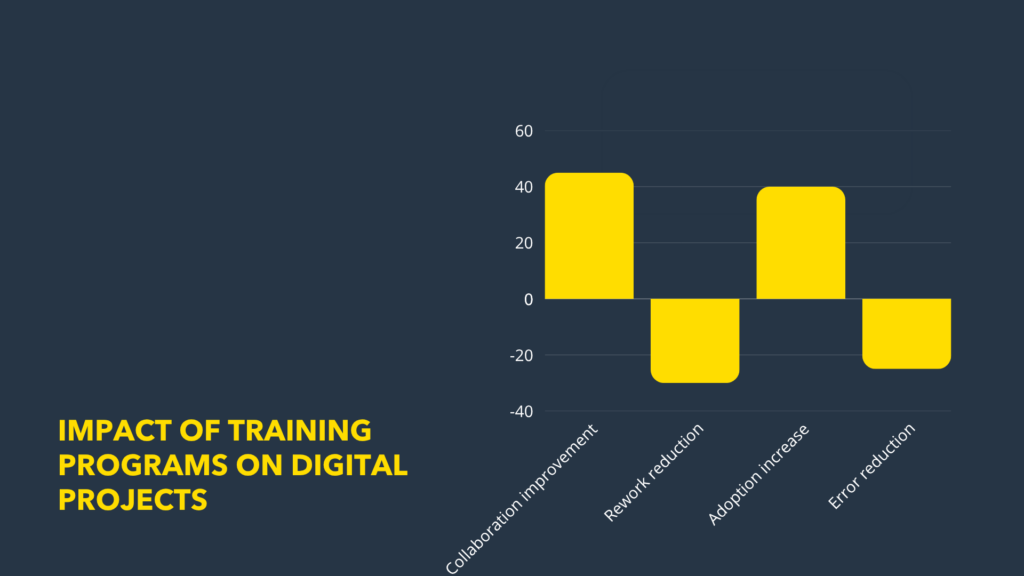
Training Academies help organizations develop shared knowledge, establish a common language, and create a unified understanding of business objectives.
When both sides understand each other’s priorities and challenges, collaboration becomes significantly more productive.
Key benefits include:
- Stronger cross-functional collaboration.
- Better understanding of strategic goals.
- Reduced rework.
- Lower resistance to change.
- Higher technology adoption rates.
Furthermore, customized training programs allow organizations to address specific business challenges while accelerating measurable outcomes.
Custom Software That Connects Business Goals and Technology Capabilities
Training alone cannot eliminate every challenge. Organizations also need technology solutions designed around their actual business processes.
This is where Custom Software becomes essential.
Custom-built solutions translate strategic objectives into tools that support day-to-day operations. They also encourage continuous collaboration among business stakeholders, end users, and technology teams throughout the development lifecycle.
This approach delivers several advantages:
- Better alignment with business processes.
- Improved user experience.
- Greater adaptability to business goals.
- Scalability for future growth.
- Stronger return on investment.
When business and technology collaborate from the beginning, organizations create solutions that deliver measurable value.
Turning Communication into a Competitive Advantage
Digital transformation depends on more than platforms, applications, or infrastructure. Its success ultimately relies on people working toward shared goals.
Organizations that strengthen communication between business and IT reduce project risks, improve adoption rates, and maximize technology investments.
Technology remains a critical enabler. However, the difference between successful and unsuccessful initiatives often comes down to a much simpler factor: the ability to communicate effectively.
Ready to improve IT-business alignment across your organization? Explore how our Training Academies and Custom Software services help organizations build stronger collaboration, accelerate adoption, and achieve measurable business outcomes.
Xideral Team