
Artificial intelligence training has become one of the most important competitive differentiators in today’s technology and financial services industries. While organizations continue investing in GenAI platforms, automation tools, and advanced analytics, many teams still lack the practical skills required to generate measurable business value.
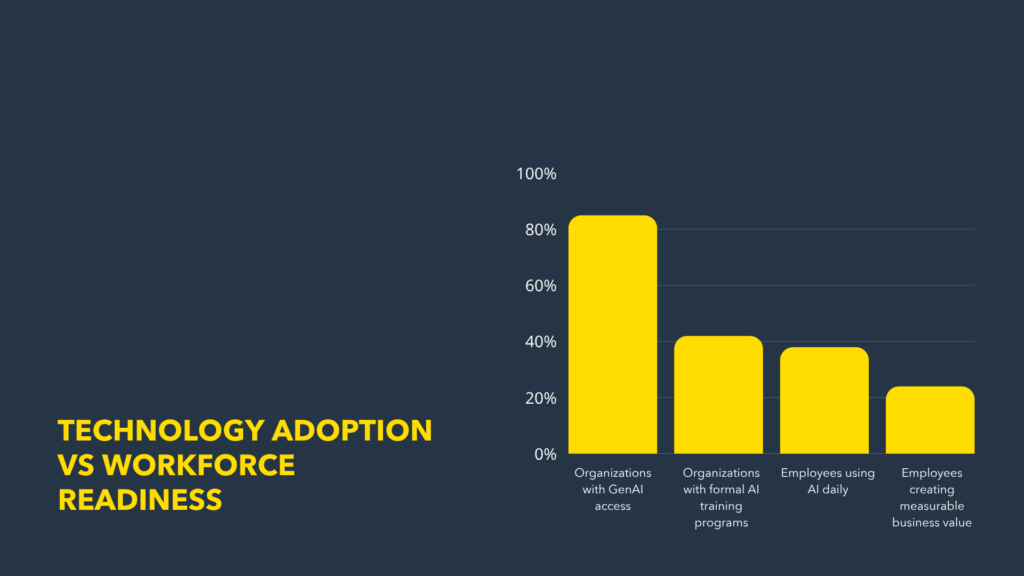
As AI adoption accelerates, workforce readiness struggles to keep pace. Consequently, companies face lower adoption rates, inefficient processes, and delayed returns on technology investments.
The challenge is no longer access to AI.
The challenge is building the capabilities needed to use it effectively.
How Artificial Intelligence Training Closes the Skills Gap
Generative AI has made advanced technologies more accessible than ever before. Today, organizations can deploy intelligent assistants, automate workflows, and generate insights within weeks.
However, access does not guarantee impact.
Many organizations encounter obstacles such as:
- Limited AI adoption across teams.
- Underutilized software licenses.
- Knowledge gaps among employees.
- Lack of implementation frameworks.
- Governance and compliance concerns.
As a result, businesses often invest heavily in technology while struggling to translate those investments into measurable outcomes.
Organizations that prioritize skills development create a stronger foundation for innovation and operational efficiency.
Why GenAI Adoption Is Outpacing Workforce Development
Several factors contribute to the growing gap:
AI technologies evolve rapidly
Traditional training programs move slowly
Organizations prioritize technology purchases
Leadership often underestimates reskilling needs
AI talent remains scarce in the market
Consequently, many companies own powerful tools that their teams cannot fully leverage.
Why Artificial Intelligence Training Creates Competitive Advantage
Leading organizations understand that technology alone does not create differentiation.
Competitive advantage emerges when technology, processes, and people work together.
Companies that invest in capability development often achieve:
- Faster AI adoption.
- Higher productivity.
- Improved decision-making.
- Reduced operational inefficiencies.
- Greater innovation capacity.
- Stronger return on technology investments.
Furthermore, employees become more confident when integrating AI into daily operations.
That confidence translates into faster execution and better business outcomes.
The Role of Corporate Academies in the AI Era
Corporate academies help organizations accelerate workforce transformation through structured learning experiences.
Unlike isolated training sessions, academy-based models focus on developing practical competencies that employees can immediately apply.
Key benefits include:
- Hands-on learning.
- Real-world business scenarios.
- Faster skill acquisition.
- Consistent knowledge standards.
- Preparation for emerging technologies.
Organizations that continuously invest in learning build a workforce capable of adapting to ongoing technological change.
The Future Belongs to Organizations That Build Capabilities
Artificial intelligence will continue reshaping industries throughout the coming decade.
However, the organizations that achieve sustainable success will not necessarily be those that purchase the most software.
They will be the ones that develop the strongest capabilities.
AI tools are increasingly available to everyone.
The skills required to unlock their full value are not.
Organizations that invest in continuous learning, workforce development, and specialized academies will be better positioned to innovate, compete, and grow in an AI-driven economy.
Discover how specialized training academies can help your organization close the skills gap and transform AI investments into measurable business results.
Xideral Team