

Business process automation has become a strategic priority for manufacturing and retail companies seeking greater efficiency, lower costs, and improved customer experiences. Yet many organizations make a critical mistake: they purchase software expecting it to solve operational problems that actually originate from poorly designed processes.
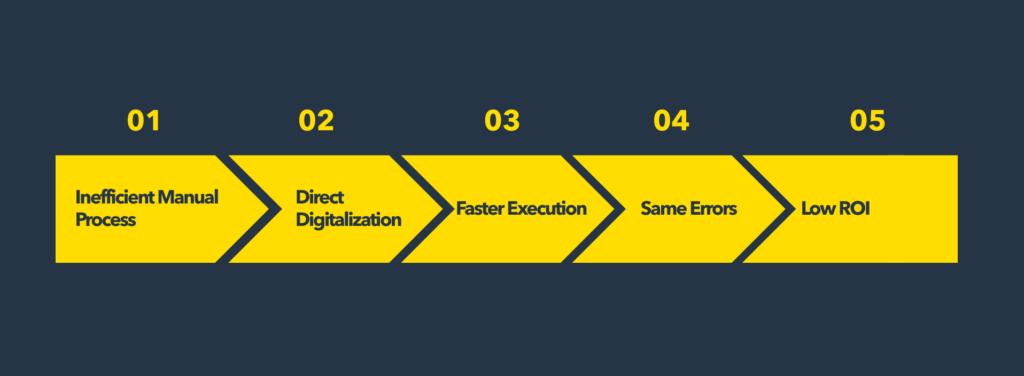
As a result, technology investments often fail to deliver meaningful outcomes. Instead of eliminating inefficiencies, new systems simply execute flawed activities faster.
The reality is straightforward: automating a bad process only helps organizations make mistakes more quickly.
Business process automation cannot fix operational inefficiencies
Companies frequently notice symptoms such as delays, manual errors, low productivity, or inconsistent results. Consequently, they invest in technology hoping for rapid improvement.
However, the root cause is rarely the software itself.
Common operational issues include:
- Redundant workflows.
- Poorly documented procedures.
- Unclear ownership and responsibilities.
- Excessive approval layers.
- Inconsistent data across departments.
When these problems remain unresolved, any technology initiative inherits the same weaknesses.
For example, if a procurement process requires five unnecessary approvals, a digital system will still execute those five approvals. The workflow becomes faster, but it remains inefficient.
How to achieve effective business process automation
Organizations that generate measurable results start with operational analysis before implementing technology.
This approach helps identify bottlenecks, duplicated activities, and opportunities for improvement.
A successful transformation typically follows these steps:
Map existing workflows.
Identify non-value-added activities.
Standardize procedures.
Define performance metrics.
Design optimized workflows.
Implement technology solutions.
As a result, technology becomes an enabler of efficiency rather than a mechanism for amplifying existing problems.
Furthermore, employees adopt new tools more effectively because they understand the purpose behind the transformation.
Manufacturing and retail benefit most from business process automation
Manufacturing and retail organizations manage complex operations involving supply chains, inventory, logistics, production, and customer service.
Therefore, even small inefficiencies can generate significant operational impact.
Processes that often benefit from optimization before automation include:
- Inventory management.
- Production planning.
- Automated replenishment.
- Quality control.
- Order management.
- Logistics tracking.
- Customer support.
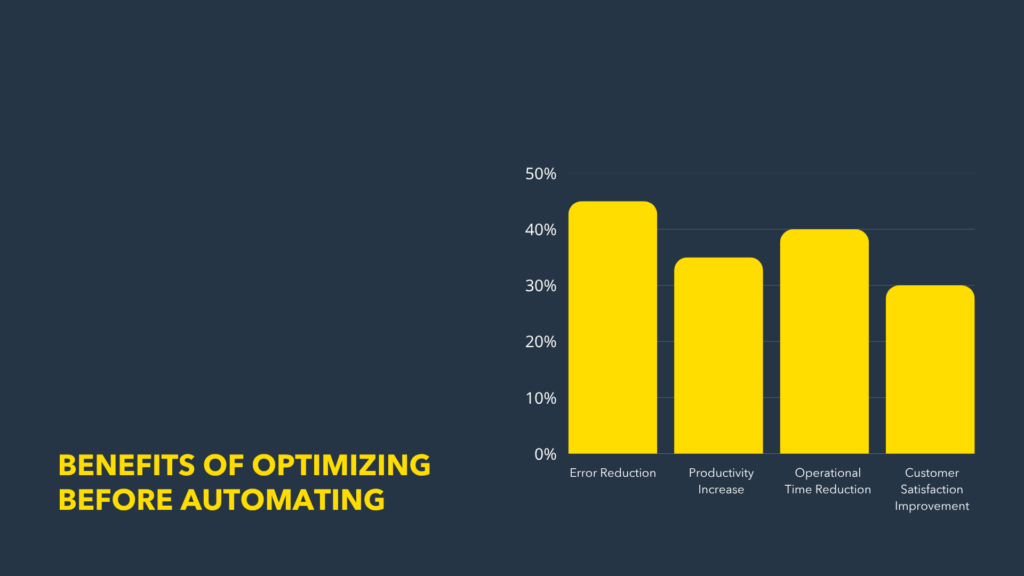
Once organizations redesign these workflows effectively, they typically achieve:
- Faster operations.
- Fewer errors.
- Better traceability.
- Improved customer experience.
- Higher productivity.
The role of custom software in automation success
Commercial platforms provide valuable capabilities, but they do not always align with unique operational requirements.
For this reason, many organizations invest in custom software development to support optimized workflows.
Through Custom Software and Software Factory services, companies can:
- Integrate existing systems.
- Eliminate manual tasks.
- Centralize information.
- Automate critical workflows.
- Scale operations efficiently.
This strategy enables businesses to build solutions aligned with their objectives while improving long-term return on investment.
Technology alone does not transform operations. Organizations must first analyze and improve their workflows before investing in software.
Otherwise, digital tools will simply accelerate the same inefficiencies they were intended to eliminate.
Companies that combine process optimization, technology strategy, and specialized software development achieve more sustainable, scalable, and profitable automation initiatives.
Looking to optimize operations before investing in technology? Discover how Software Factory services can help build efficient and scalable business processes. Visit: https://xideral.ca
Xideral Team